
Can a Broken Denture Be Repaired the Same Day?
Yes, in most cases a broken denture can be fixed with same day broken denture repair, by a…
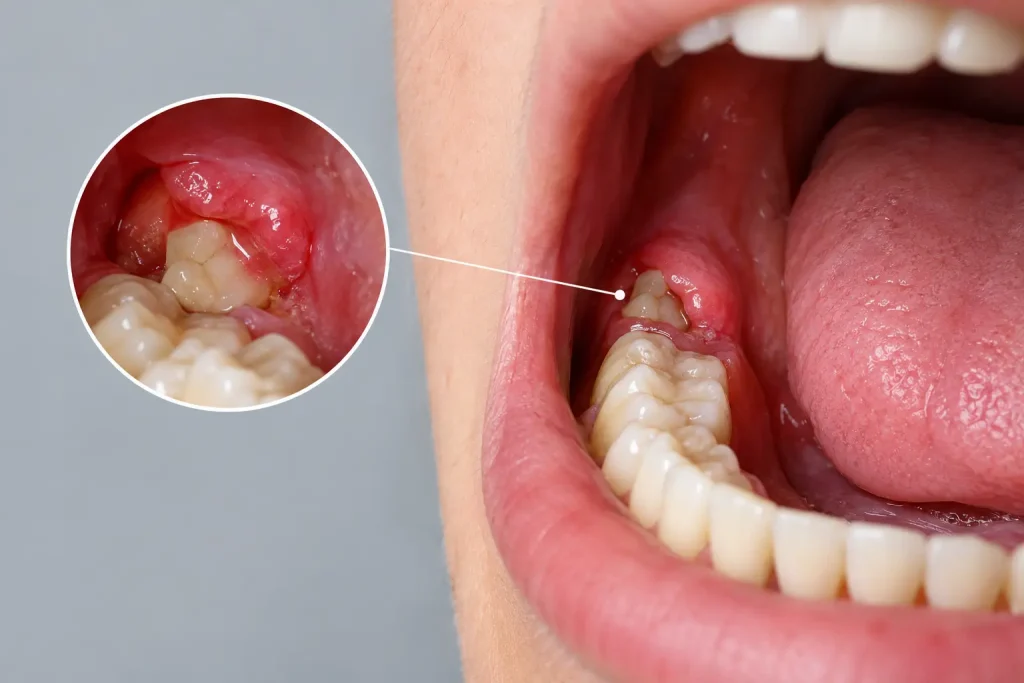
The clearest signs of an infected wisdom tooth are swelling around the gum, a bad taste or visible pus, pain that spreads toward your ear or jaw, and difficulty opening your mouth fully. If you’re noticing more than one of these together, it’s worth getting it checked rather than waiting to see if it settles on its own.
If you’re in North Acton, Chiswick, or anywhere else across West London and you’re not sure whether what you’re feeling is just normal wisdom tooth discomfort or an infected wisdom tooth that actually needs treating, here’s how to tell the difference, what usually causes it, and what happens next.
Wisdom teeth are more prone to infection than other teeth simply because of where they sit and how they tend to come through.
| Cause | Why It Happens |
|---|---|
| Partial eruption | The tooth only partly breaks through the gum, leaving a flap of tissue that traps food and bacteria |
| Impaction | The tooth is stuck against another tooth or bone, creating a pocket that’s hard to keep clean |
| Difficult access | Wisdom teeth sit right at the back, making brushing and flossing around them genuinely harder |
| Existing decay | Decay reaching the nerve of a partially erupted tooth can trigger infection from the inside |
Most wisdom tooth infections come down to pericoronitis, where the gum flap sitting over a partially erupted tooth becomes inflamed and infected. Because that flap doesn’t disappear on its own, food and bacteria keep getting trapped underneath it, which is why the same infection often flares up again and again until it’s properly treated.
When a wisdom tooth is impacted, it’s unable to fully erupt because it’s blocked by the tooth next to it or by bone. This creates a tight pocket around the tooth that’s almost impossible to clean properly, so bacteria build up there far more easily than anywhere else in the mouth.

A few signs specifically suggest infection rather than ordinary discomfort as the tooth comes through:
One or two of these on their own might just mean the tooth is coming through normally. Several together, especially swelling combined with a bad taste or fever, point more clearly toward an infected wisdom tooth rather than ordinary discomfort.
Most wisdom tooth infections can be managed with a same day dental appointment, but certain symptoms mean you shouldn’t wait:
Any of these point toward a more serious infection that needs prompt attention rather than home management alone.
An untreated wisdom tooth infection doesn’t tend to resolve by itself.
Left alone, it can spread to nearby teeth and gum tissue, or develop into a wisdom tooth abscess, a more advanced, pus-filled infection that needs urgent treatment.
Even if the swelling settles down temporarily, pericoronitis around a partially erupted tooth tends to return again and again, since the gum flap trapping bacteria doesn’t go away on its own. Catching it early, while it’s still just localised swelling and discomfort, is what keeps treatment simple.
X-rays at your assessment show exactly what’s happening beneath the gum, including whether the tooth is impacted and how close the infection sits to nearby teeth or nerves.
For milder cases, cleaning under the gum flap and a short course of antibiotics can settle the infection, particularly if it’s an early flare-up of pericoronitis rather than a recurring problem.
Where infections keep returning or the tooth is significantly impacted, same-day wisdom tooth extraction is often possible in one visit, removing the underlying cause rather than just treating the latest flare-up.
If swelling has already progressed further into a dental abscess, drainage alongside antibiotics is usually needed before the tooth itself can be properly assessed or removed.
As an emergency dentist near me search often shows, finding same day care for a suspected infected wisdom tooth shouldn’t be complicated. X-rays at your assessment show exactly what’s happening beneath the gum, and where the tooth needs treating, same-day wisdom tooth extraction is often possible in one visit.
If swelling has already progressed further, a dental abscess needing urgent treatment is assessed the same day too, whether you’re coming from Ealing or Park Royal.
Normal eruption usually causes mild, localised discomfort. Infection tends to bring swelling, a bad taste, pus, or pain spreading toward your ear or jaw, often alongside difficulty opening your mouth fully.
It can settle temporarily, especially with rinsing and painkillers, but the underlying cause usually remains and the infection tends to return until it's properly treated.
Antibiotics are sometimes prescribed if the infection is spreading, but they treat the spread of infection rather than the cause, so the tooth itself usually still needs assessment.
Most cases can be treated with a prompt appointment, but swelling affecting your breathing or swallowing, or a high fever, needs immediate attention.
Pericoronitis is inflammation and infection of the gum flap covering a partially erupted wisdom tooth, and it's the most common cause of wisdom tooth infections.
Sometimes, if it's an early, isolated flare-up treated with cleaning and antibiotics. Recurring infections usually mean extraction is the more lasting solution.
Mild, localised discomfort is common during normal eruption. Pain spreading beyond the tooth, swelling, or a bad taste suggests infection rather than normal eruption.
An infected wisdom tooth usually shows itself through swelling, a bad taste, and pain that spreads beyond the tooth itself, most often caused by pericoronitis around a partially erupted tooth.
Whether you’re in Acton, Hanwell, or elsewhere across West London, catching it early with a proper assessment means dealing with the cause once, rather than managing repeated flare-ups.
Yes, in most cases a broken denture can be fixed with same day broken denture repair, by a…
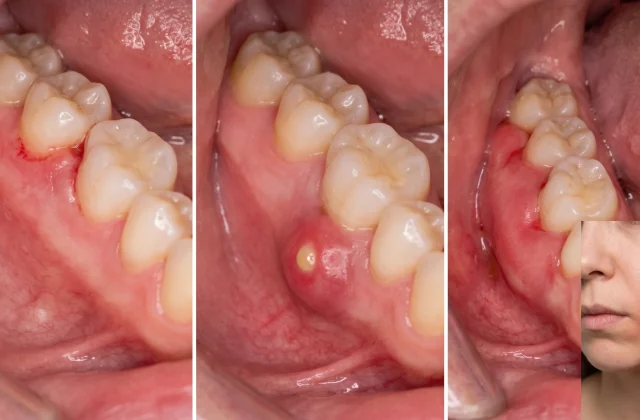
The stages of a gum abscess move in a fairly predictable order, from mild gum inflammation and tenderness,…
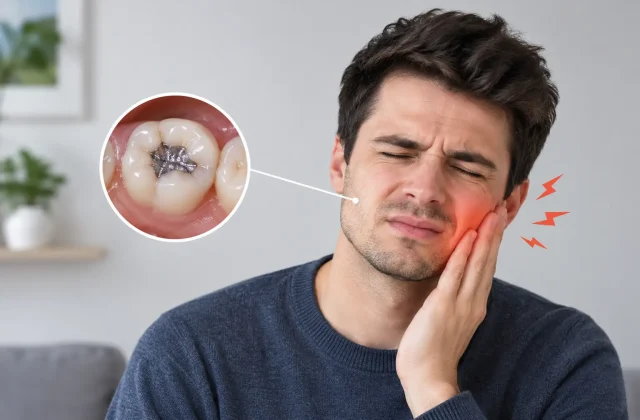
Some sensitivity after a filling is completely normal, usually a mild reaction to hot or cold that settles…
Don't wait for it to worsen. Book online or give us a call to secure a same-day appointment.